

For years, a proof of concept was exactly what its name suggested: an opportunity to prove the concept. If your technology solved the customer’s problem better than the alternatives, there was a good chance you would win the deal. The evaluation was largely technical, and technical superiority usually translated into commercial success.
Enterprise buying has changed.
Over the last few months, I’ve spoken with dozens of founders, CISOs and enterprise security leaders about why technically brilliant startups struggle to convert successful POCs into long-term customers. Some conversations focused on AI security, others on identity, browser security, endpoint protection or cloud infrastructure. The technologies were different, but the pattern was remarkably consistent.
That’s an important distinction. It changes how founders should think about enterprise sales, and how enterprise security teams should think about evaluating innovation.
Why Founders Think a POC Means the Deal Is Won
From the founder’s perspective, the buying journey feels logical:
- Problem identified
- Product built
- Capital raised
- Introductions secured
- Security architect aligned
- Platform engineering engaged
- IAM lead focused on integrations
Eventually, you hear the sentence every founder wants to hear.
“Let’s run a POC.”
At that point, it feels as though the hardest part is behind you.
The assumption is simple: if technology performs, the deal should naturally follow.
For a long time, that wasn’t an unreasonable assumption. Enterprise cybersecurity rewarded technical superiority. If your solution delivered stronger detection, lower operational overhead, richer telemetry or integrated more cleanly into an existing security stack, there was a reasonable expectation that the better product would win.
Increasingly, that’s only half the story.
What the CISO Is Actually Evaluating
While the founder leaves the meeting thinking about technical differentiation, the CISO walks into another meeting thinking: “Great guys, good technology, but does my organization have the capacity to deal with that?”
The Seven Questions Behind Every POC Decision
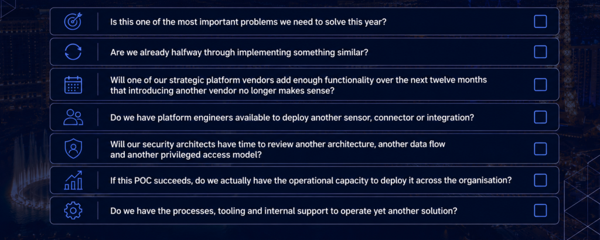
The conversation inside the enterprise rarely begins with the product itself. Instead, it begins with a different set of questions:
- Is this one of the most important problems we need to solve this year?
- Are we already halfway through implementing something similar?
- Will one of our strategic platform vendors add enough functionality over the next twelve months that introducing another vendor no longer makes sense?
- Do we have platform engineers available to deploy another sensor, connector or integration?
- Will our security architects have time to review another architecture, another data flow and another privileged access model?
- If this POC succeeds, do we actually have the operational capacity to deploy it across the organization?
- Do we have the processes, tooling and internal support to operate yet another solution?
Notice how few of those questions are really about technology.
They’re about everything surrounding the technology.
One security leader described a startup whose product genuinely impressed the evaluation team. The technology was stronger, the deployment model was cleaner and the roadmap was compelling. The POC still stalled.
Not because the technology failed, but because the organization had already committed itself to another strategic initiative. Engineers had spent months implementing it. Architects had signed off on it. Procurement was already well underway. Internal champions had invested political capital getting it approved. Even if the new product was objectively better, changing direction carried a cost the organization wasn’t prepared to absorb.
Another security leader described pausing an entirely different category of products. Again, technology wasn’t the issue. Engineering resources were already committed elsewhere, architecture teams were stretched, and there simply wasn’t a credible path from a successful POC to a successful production deployment.
You’re Not Competing Against Another Startup
Across these conversations, one theme kept emerging. Founders believed they were competing against another startup.
In reality, they were often competing against engineering bandwidth, implementation timelines, governance, procurement, projects already underway and, increasingly, the expectation that an incumbent platform would eventually deliver a “good enough” version of the capability.
What Founders Should Do Differently: Qualify Readiness, Not Just the Problem
The findings point to a different challenge than most sales methodologies acknowledge.
Founders don’t just need to qualify the technical problem. They need to qualify the organization’s readiness to change. And qualify it hard and early.
That means understanding what strategic initiatives are already underway, where engineering capacity is already being consumed, whether the customer is waiting for an incumbent platform to close the gap, and what would actually need to happen for a successful POC to become a production deployment.
These aren’t objections to overcome.
They’re realities to understand.
If your internal champion has already invested months backing another initiative, pretending it doesn’t exist won’t make it disappear. Help them build the business case for changing direction. Help them quantify the operational value. Help them explain why changing course creates more long-term value than continuing with yesterday’s decision.
Because if you’re asking an enterprise to replace an existing initiative, you’re not simply asking them to buy different software. You’re asking them to revisit architecture decisions, engineering effort, procurement work and months of organizational momentum.
The founders who consistently succeed aren’t just better at selling technology.
They’re better at helping organizations navigate change.
What CISOs Should Do Differently: Evaluate Without Overcommitting
The same conversations point to a challenge inside the enterprise.
Innovation is moving faster than enterprise evaluation processes were designed to handle. Security teams are now being asked to assess AI-native startups, new identity models, browser security, runtime protection and entirely new categories of technology, often using governance processes built for a market that moved much more slowly.
Maintaining high standards is essential, but every lengthy evaluation has an opportunity cost. Every six-month POC consumes engineering capacity, architecture reviews, operational attention and executive sponsorship. The longer those resources remain tied up, the harder it becomes to evaluate the next wave of innovation.
The challenge isn’t to lower the bar.
It’s to build an organization that can evaluate innovation rigorously without making every evaluation a major organizational commitment.
The Real Constraint: Change Capacity, Not Innovation
The conversations behind this all pointed to the same conclusion.
Enterprise buying hasn’t become harder because founders are building worse products or because CISOs have become more risk averse. It’s become harder because innovation has accelerated while an organization’s ability to absorb change hasn’t kept pace.
For founders, success now depends as much on understanding the organization as it does on understanding the technical problem. The best founders don’t just prove their product works. They help customers understand how to act on the outcome.
For CISOs, the challenge is different. As innovation continues to accelerate, the organizations that consistently identify the next generation of category-defining companies won’t necessarily have larger budgets or bigger security teams. They’ll be the organizations that become better at evaluating new technology without overwhelming the people responsible for deploying it.
That raises an interesting question.
If the ability to evaluate innovation is becoming a competitive advantage in itself, what should a modern enterprise evaluation process actually look like?